Hyster-Yale and NTT Data Deploy Physical AI on Factory Floor
Hyster-Yale and NTT Data have deployed a physical AI system that checks forklift assembly steps and flags errors in real time.
What Happened
Hyster-Yale Materials Handling and NTT DATA announced on July 7, 2026 a joint deployment of physical AI technology on Hyster-Yale's manufacturing floor, embedding machine perception directly into the assembly process to detect errors before finished products leave the factory. Early results from the deployment show that implementation timelines have been cut from months to weeks.
Background
Hyster-Yale Materials Handling, Inc. (HYMH) is a major U.S.-based manufacturer of lift trucks and materials handling equipment, operating under the Hyster and Yale brand names. NTT DATA is a global IT services and infrastructure company headquartered in Tokyo.
The two companies did not disclose the financial terms of the arrangement. The announcement was distributed via Business Wire and covered by the American Journal of Transportation and Stock Titan on July 7, 2026.
Physical AI, sometimes called embodied AI, refers to artificial intelligence systems that perceive and act on the physical world through sensors and cameras rather than operating purely on digital data. In manufacturing contexts, physical AI systems are typically deployed to monitor production lines, identify assembly deviations, and surface quality control issues without requiring manual inspection at every stage.
What the System Does
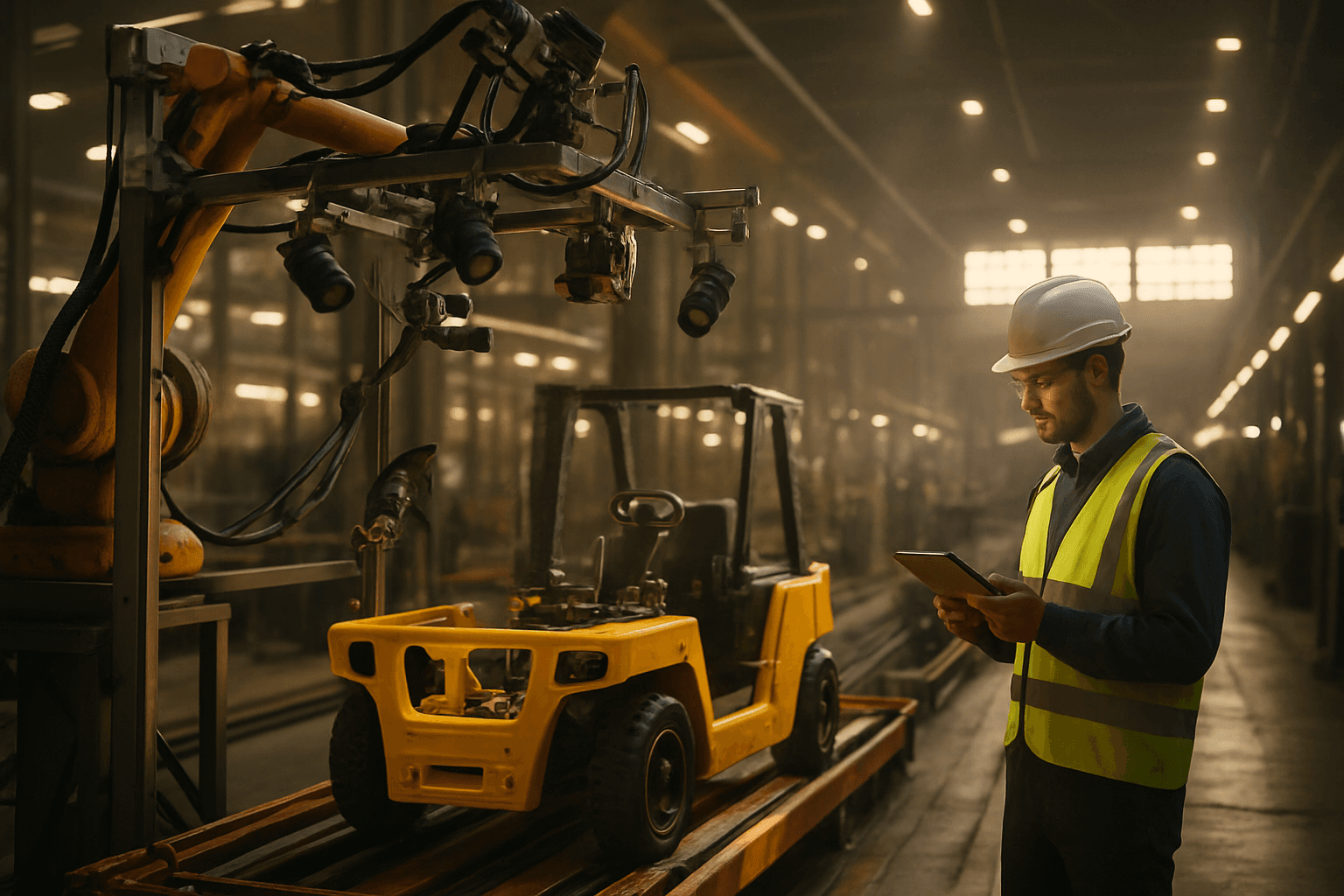
According to the announcement, the solution embeds AI-based sensing and inference directly into Hyster-Yale's assembly workflow. The system monitors individual assembly steps and flags deviations in real time, allowing factory personnel to address errors before products complete the production process.
NTT DATA described the deployment as a breakthrough application of physical AI in manufacturing. The companies stated that the time required to deploy the system at a facility was reduced significantly compared with prior AI implementation projects, with the transition from planning to operational deployment measured in weeks rather than months.
Neither company provided specific figures on error detection rates, defect reduction, or cost savings in the materials distributed on July 7.
Industry Context
The announcement comes as physical AI applications in manufacturing have drawn increased attention from industrial companies seeking to improve quality control and reduce waste on production lines. Several technology vendors and industrial firms have announced similar programs in recent months, applying computer vision and edge AI to assembly verification tasks that were previously handled by human inspectors or end-of-line testing.
Hyster-Yale's adoption of the technology is notable given the complexity of lift truck assembly, which involves multiple mechanical and safety-critical components. Errors in forklift assembly can carry significant liability implications, making pre-shipment quality verification a high-priority process for the company.
NTT DATA has expanded its manufacturing AI services portfolio in recent years, working with industrial clients across automotive, logistics, and heavy equipment sectors. The Hyster-Yale deployment represents one of the company's publicly announced applications of physical AI in U.S. heavy equipment manufacturing.
What It Means in Practice
Under the deployment as described, cameras and sensors positioned at assembly stations capture step-by-step production data. The AI system compares observed assembly states against reference configurations and generates alerts when deviations are detected. Factory workers can then intervene at the point of error rather than discovering problems during final inspection or after shipment.
The reduction in deployment timeline, from months to weeks, was cited by both companies as a key operational outcome. Faster deployment allows manufacturers to bring AI quality checks online sooner after a decision to implement, reducing the gap between investment approval and measurable impact on the production floor.
Hyster-Yale and NTT DATA did not announce specific plans for expanding the system to additional facilities or product lines in the July 7 release, but both companies indicated the partnership is ongoing.
Get our editors' take on what it all means. Read the Editor's Blog →