Penn Researchers Create Light-Matter Particle to Accelerate AI Computing
University of Pennsylvania researchers have developed a hybrid light-matter particle that could significantly speed up AI computing while reducing energy use.
What Happened
Researchers at the University of Pennsylvania have created a hybrid light-matter particle that they say could dramatically increase the speed of AI computing while consuming substantially less energy than conventional electron-based systems. The development, reported by ScienceDaily on May 18, 2026, represents an attempt to move beyond traditional semiconductor-based computing architectures that currently underpin most AI hardware.
Background
Conventional AI computing relies on the movement of electrons through silicon-based chips. This approach has driven decades of performance gains, but the energy demands of large-scale AI systems have grown sharply in recent years. Data centres running AI workloads now account for a measurable and rising share of global electricity consumption. Researchers across multiple institutions have been investigating alternative physical substrates, including photonic systems, quantum devices, and hybrid architectures, as potential pathways to more efficient computation.
Polaritons, which are the class of hybrid light-matter quasiparticles at the centre of the Penn research, have been studied in physics laboratories for several decades. They arise when photons, the particles of light, couple strongly with electronic excitations in a material, producing a new entity that carries properties of both. Earlier research demonstrated that polaritons could be manipulated at room temperature under specific material conditions, though practical applications in computing remained elusive.
The Research
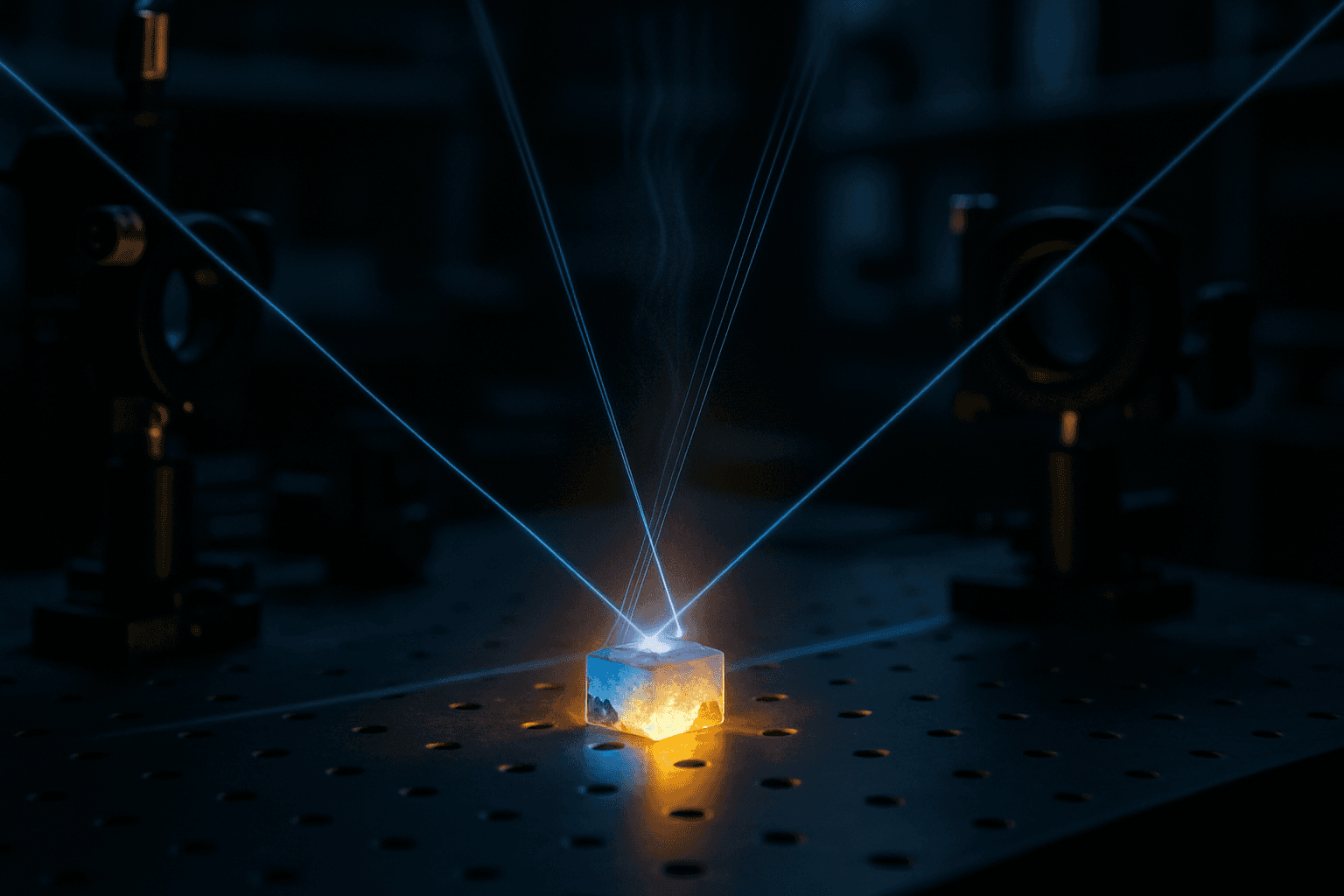
The Penn team's work focuses on engineering these hybrid particles in a form that can be practically applied to computing tasks relevant to AI workloads. According to the ScienceDaily report, the researchers created a system in which the light-matter particles can be used to perform the types of matrix operations that form the computational core of modern neural networks. Those operations, repeated billions of times during AI training and inference, are the primary driver of energy consumption in current hardware.
The researchers reported that the approach could deliver substantial gains in both processing speed and energy efficiency compared to electron-based systems, though the ScienceDaily summary does not specify precise benchmark figures or the conditions under which those comparisons were made. The work is based at Penn's laboratory facilities and has not yet been described in the context of a commercial product or a specific hardware deployment timeline.
What It Means in Practice
Physics-based computing research frequently requires a long path from laboratory demonstration to manufacturable hardware. The transition from a proof-of-concept quasiparticle system to chips that can be fabricated at scale involves materials science, engineering, and industrial manufacturing challenges that are separate from the underlying physics result. The Penn announcement does not include partnerships with semiconductor manufacturers or timelines for commercialisation.
Nevertheless, the research addresses a recognised constraint in the AI industry. Major cloud providers, chip manufacturers, and AI laboratories have all publicly acknowledged that energy consumption is a limiting factor in the continued scaling of AI systems. Hardware approaches that reduce the energy cost per operation have commercial as well as environmental relevance, and academic breakthroughs in this area frequently attract follow-on funding and industry interest.
The polariton-based approach also differs from photonic computing efforts already underway at companies including Lightmatter and others, which use conventional photons rather than hybrid light-matter particles. Whether the Penn approach offers advantages over those existing photonic architectures is not addressed in the available wire report summary.
What Comes Next
The full details of the Penn research, including methodology, materials used, and performance data, are expected to be available in the peer-reviewed publication associated with the ScienceDaily release, which will allow independent researchers to evaluate and attempt to replicate the findings.
Get our editors' take on what it all means. Read the Editor's Blog →