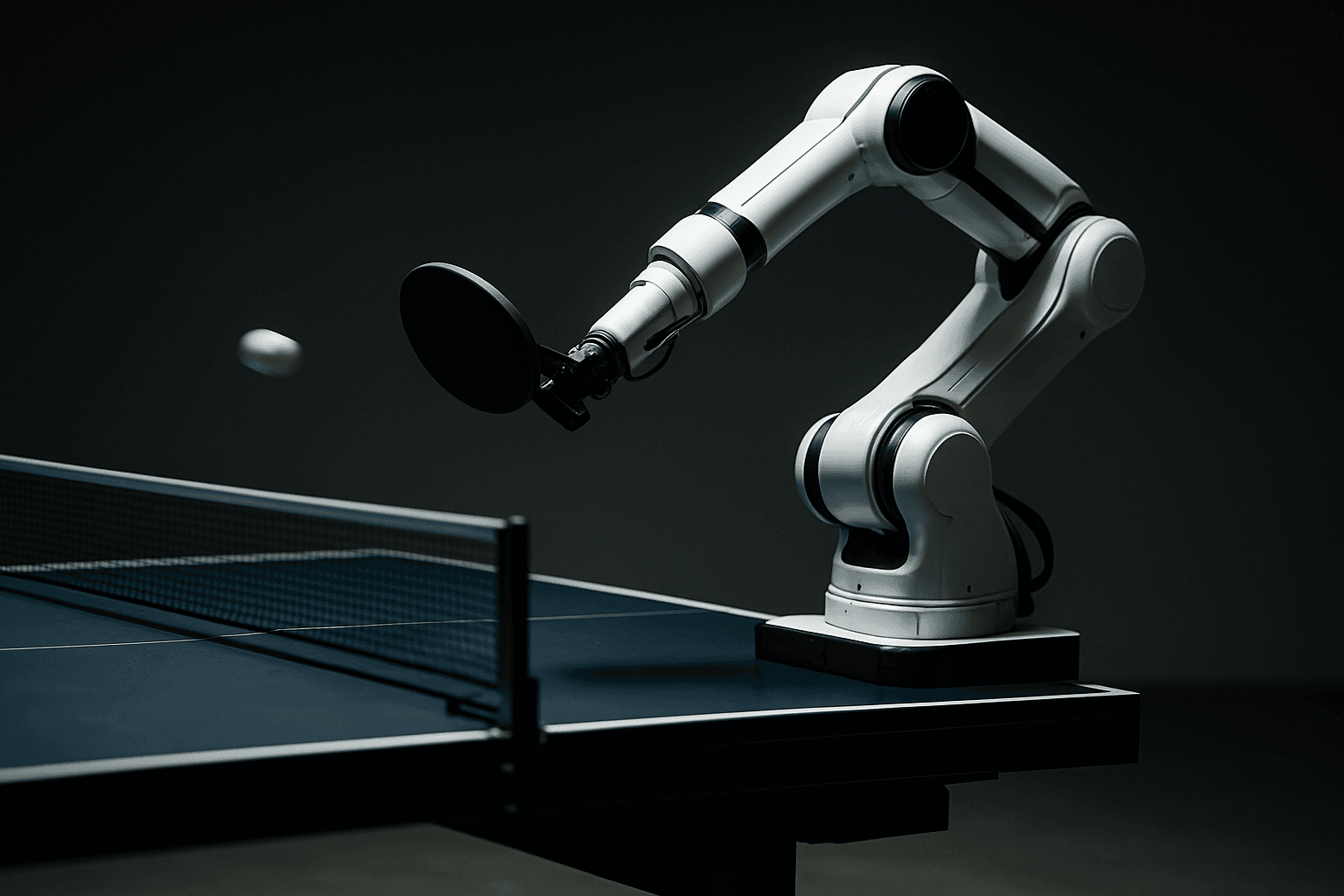
Sony Unveils Autonomous Table Tennis Robot Capable of Elite Play
Sony AI has unveiled Ace, an autonomous robot that can compete against elite human table tennis players.
Sony AI has unveiled a robot called Ace that can play table tennis autonomously against elite human competitors, marking a significant development in physical AI and robotics. The announcement was made on May 14, 2026, drawing attention for its demonstration of real-time physical decision-making in an uncontrolled, high-speed sporting environment.
What Happened
Sony AI publicly revealed Ace, an autonomous table tennis robot designed to compete at a high level against skilled human players. The system represents Sony's latest work in physical AI, a field focused on building machines that can perceive, decide, and act in dynamic real-world environments rather than operating only in digital or controlled industrial settings.
The robot was described by Sony AI as capable of competing against elite human players, though the company did not specify the exact ranking or competitive tier of the human opponents used in its demonstrations.
Background
Sony has maintained a research and development presence in robotics and artificial intelligence for several decades. The company's AI division, Sony AI, was established in 2020 with a stated focus on three core areas: gaming, imaging and sensing, and gastronomy. Physical AI and robotics have become an increasingly prominent area of investment across the technology sector, with companies including Boston Dynamics, Figure AI, and Tesla developing autonomous systems capable of operating in unstructured environments.
Table tennis presents a specific set of technical challenges for autonomous systems. The sport requires tracking a lightweight ball traveling at speeds that can exceed 100 kilometres per hour, calculating trajectories in milliseconds, and executing precise physical responses using a robotic arm or body. These requirements place simultaneous demands on computer vision, sensor fusion, motion planning, and mechanical actuation.
What the System Does
Ace is described as an autonomous system, meaning it operates without real-time human input during play. The robot must independently perceive the ball's position and velocity, anticipate its trajectory, and coordinate a physical response within the time constraints of a live rally.
Sony AI characterised the development as a major breakthrough in physical AI. The company did not release a detailed technical paper or full specification sheet alongside the announcement. Specific figures on reaction time, rally length, or win-loss records against human opponents were not included in the available wire reports at the time of publication.
Industry Context
The unveiling of Ace fits within a broader pattern of technology companies using sports and games as benchmarks for AI capability. DeepMind previously used games including Go and chess to demonstrate advances in decision-making AI. Physical sports introduce variables that purely digital environments do not, including imperfect real-world physics, mechanical latency, and the unpredictability of human opponents.
Physical AI has attracted increased investment and attention in 2025 and 2026, with robotics companies pursuing applications in manufacturing, logistics, healthcare, and consumer products. Sony's entry into competitive physical AI demonstrations positions Ace as a showcase of the company's broader technical capabilities in perception and real-time control systems.
Sony AI has not announced a commercial product or deployment timeline connected to the Ace robot. The demonstration appears to function primarily as a proof-of-concept for the underlying technologies involved.
What Happens Next
Sony AI has not publicly detailed the next stage of development for Ace or indicated whether the technology will be presented at additional events or submitted for peer-reviewed publication.
Get our editors' take on what it all means. Read the Editor's Blog →